
NEWS & INSIGHTS

When Automatic Gratuity Meets Federal Wage Law: A Florida Sales Tax and FLSA Crossroads for Restaurants and Hospitality Businesses
Florida restaurants that add automatic gratuities often assume tax compliance means wage compliance. It does not. This article breaks down where Florida’s sales tax exemption for gratuities and the federal wage rules under FLSA Section 203(m) diverge, and what that gap means for owners, CPAs, and counsel, including nightclubs, hotels, caterers, and clubs.
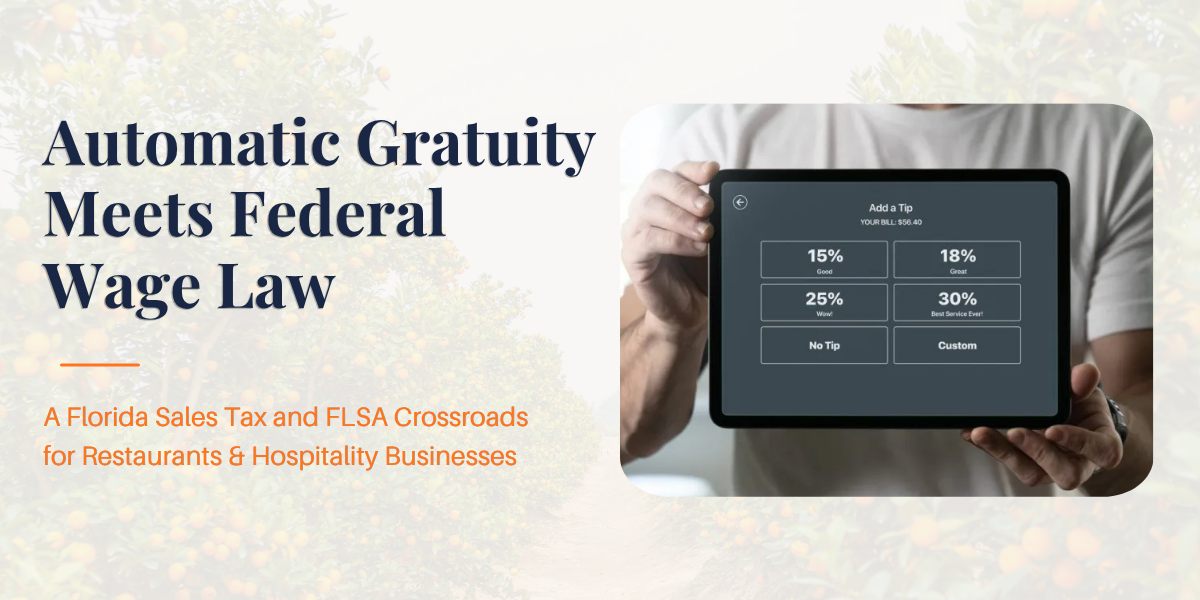
When Automatic Gratuity Meets Federal Wage Law
Florida restaurants have grown comfortable with automatic gratuities. Large parties get an automatic charge, usually eighteen to twenty percent, added to the bill. Owners assume that if the charge is properly documented for sales tax purposes, the wage law side of the equation takes care of itself. It does not.
This gap between Florida sales tax treatment and federal wage law creates real exposure. Tax practitioners advising restaurant clients need to understand both sides of this intersection, because a client can be fully compliant with the Department of Revenue and still be in violation of the Fair Labor Standards Act on the very same transaction.
The Florida Sales Tax Framework
Florida Administrative Code Rule 12A-1.0115(7)(a) governs the taxability of gratuities. Under this rule, a gratuity charge is excluded from the taxable sales price only when two conditions are met. First, the charge must be separately stated on the receipt or other evidence of sale. Second, the dealer must receive no monetary benefit from the gratuity.
The rule also clarifies that certain deductions do not disqualify the exemption. Withholding for the employee’s share of Social Security or federal income tax is permitted. A credit card processing fee tied to the gratuity amount is permitted. Withholding under a judicial or administrative order is permitted. None of these count as a monetary benefit to the dealer under the rule.
Notably, the rule does not require the gratuity to be voluntary. A mandatory, automatically added gratuity can still qualify for the sales tax exemption, provided it is separately stated and fully passed through to staff.
The Federal Wage Law Framework
Federal wage law asks a different question. Under 29 U.S.C. Section 203(m), a payment only qualifies as a tip if it is voluntary and the customer determines the amount. This standard traces back to longstanding Department of Labor guidance and IRS Revenue Ruling 2012-18, both of which draw a firm line between a tip and a service charge.
An automatic gratuity added for a party of six or more may fail this test. The customer did not choose to pay it, and did not choose the amount. As a result, federal wage law treats it as a service charge, not a tip, regardless of what the receipt calls it.
This distinction controls two separate obligations under Section 203(m). First, Section 203(m)(2)(A) permits an employer to take a tip credit toward minimum wage only when all tips received have been retained by the employee. A service charge, because it is not a tip, may not support a tip credit at all. Second, Section 203(m)(2)(B) independently prohibits an employer from keeping any portion of an employee’s tips for any purpose, including through managers or supervisors.
Beyond the Restaurant Floor
This tension is not unique to sit-down dining. Rule 12A-1.0115 applies broadly to taverns, hotels, caterers, and clubs, and the same gratuity mechanics recur wherever an automatic charge is added to a customer’s bill for service. Nightclubs and bottle service present a heightened version of this problem, since bottle service typically carries an automatic gratuity or service fee of twenty percent or more, and venues frequently route a portion of that charge to management or security before distributing the remainder to servers and bottle hosts.
Hotels and resorts face the same issue at scale: mandatory banquet and event service charges under subsection (8) are common for weddings and conferences, and many hotels retain a portion of that charge as house revenue rather than passing it fully to staff, which is only lawful if the retained portion is clearly disclosed as a house charge rather than a gratuity. Caterers face parallel exposure under subsection (2)(c), since a catering contract with a built-in service charge should be reviewed the same way a restaurant receipt is, with attention to how the contract discloses the charge and its distribution. Country clubs, under subsection (12), often bundle mandatory service charges into membership dues, and unclear separation between the two creates both a taxability and a wage classification risk. Across all of these settings, a business adding a mandatory charge is making two separate legal representations at once, to the Department of Revenue and to the Department of Labor, and those representations must match the underlying facts, not just each other.
What This Means for Practitioners
Tax practitioners reviewing a restaurant client’s gratuity policy should treat the Florida sales tax exemption and FLSA compliance as two independent checklists. Passing the state test tells a client the charge is not taxable. It says nothing about wage law exposure. This applies equally to nightclub, hotel, catering, and club clients operating under related provisions of the same rule. Importantly, when engaging in sales tax planning, it is critical to consider the consequences under federal labor laws.
Restaurants and related hospitality businesses operating under ambiguous or informal gratuity policies may benefit from requesting a Florida Department of Revenue Technical Assistance Advisement to confirm treatment of a specific structure, and from reviewing Department of Revenue Tax Information Publications addressing gratuity and service charge distinctions. Neither substitutes for a wage law review by qualified employment counsel.
Florida State and Local Tax Litigation
Explore our Florida State and Local Tax Litigation. Businesses facing Florida tax disputes should be prepared for the possibility that litigation may continue beyond the trial level. Understanding how tax cases move through Florida’s appellate courts can be critical to protecting favorable rulings and challenging adverse decisions.
© 2025 Jeanette Moffa. All rights reserved.
An automatic gratuity can be exempt from Florida sales tax under Rule 12A-1.0115(7)(a) if it is separately stated on the receipt and the restaurant retains no monetary benefit from it, even though the charge is mandatory rather than voluntary.
No. Florida's tax exemption does not require the gratuity to be voluntary. It only requires separate statement on the receipt and no monetary benefit to the dealer.
A tip is voluntary and the amount is set by the customer. A mandatory charge, such as eighteen percent for large parties, is a service charge under federal wage law, regardless of the label used on the receipt.
Generally, no. Because an automatic gratuity is a service charge rather than a tip, it likely cannot be used to satisfy the tip credit requirements under 29 U.S.C. Section 203(m)(2)(A).
Yes, but only up to the actual pro-rata cost of processing that transaction. Department of Labor guidance does not permit a flat or inflated deduction that exceeds the true processing cost.
No. Florida Rule 12A-1.0115(7)(a)(2) expressly permits withholding for the employee's share of Social Security or federal income tax without disqualifying the exemption.
The Florida sales tax exemption may be lost because the restaurant received a monetary benefit and the retention itself may be a violation of the federal prohibition on employers keeping any portion of a tip.
Yes. Automatic bottle service gratuities function the same way as restaurant gratuities under both frameworks, and venues that route a portion of the charge to management before paying staff face the same compound tax and wage exposure described for restaurants.
No. Section 203(m)(2)(B) prohibits an employer from keeping any portion of an employee's tips for any purpose, including allowing managers or supervisors to retain any share, regardless of whether a tip credit is taken.
Additional Articles by the SALTy Orange at Moffa Tax Law:
Florida Department of Revenue Warns Taxpayers of Text Message Refund Scams
NEWS & INSIGHTS Florida Department of Revenue Warns Taxpayers of Text Message Refund Scams The Florida Department of Revenue is…
Florida DOR Says Nasal Strips Are Subject to Sales Tax
NEWS & INSIGHTS Florida DOR Says Nasal Strips Are Subject to Sales Tax Florida has determined that certain drug free…
The Line Between Voter Information and Political Advocacy in Florida Ballot Language
NEWS & INSIGHTS The Line Between Voter Information and Political Advocacy in Florida Ballot Language Florida’s proposed property tax amendment…

Jeanette Moffa, Esq.
(954) 800-4138
JeanetteMoffa@MoffaTaxLaw.com
Jeanette Moffa is a Partner in the Fort Lauderdale office of Moffa, Sutton, & Donnini. She focuses her practice in Florida state and local tax. Jeanette provides SALT planning and consulting as part of her practice, addressing issues such as nexus and taxability, including exemptions, inclusions, and exclusions of transactions from the tax base. In addition, she handles tax controversy, working with state and local agencies in resolution of assessment and refund cases. She also litigates state and local tax and administrative law issues.